


Attention

Cancel
OK

English


Change Password
Please select region and language
From APEC to Everyday Operations: JAKA Scales Embodied AI into Real-World Scenarios
 2026.11.25 News
Share:


As AI and robotics gain attention on the APEC innovation agenda, JAKA is demonstrating how embodied intelligence can move beyond the exhibition floor and into real-world operations.
At the APEC Journalists' Center, JAKA Lumi completed the full process of taking and fulfilling drink orders, demonstrating embodied intelligence in a public service setting.
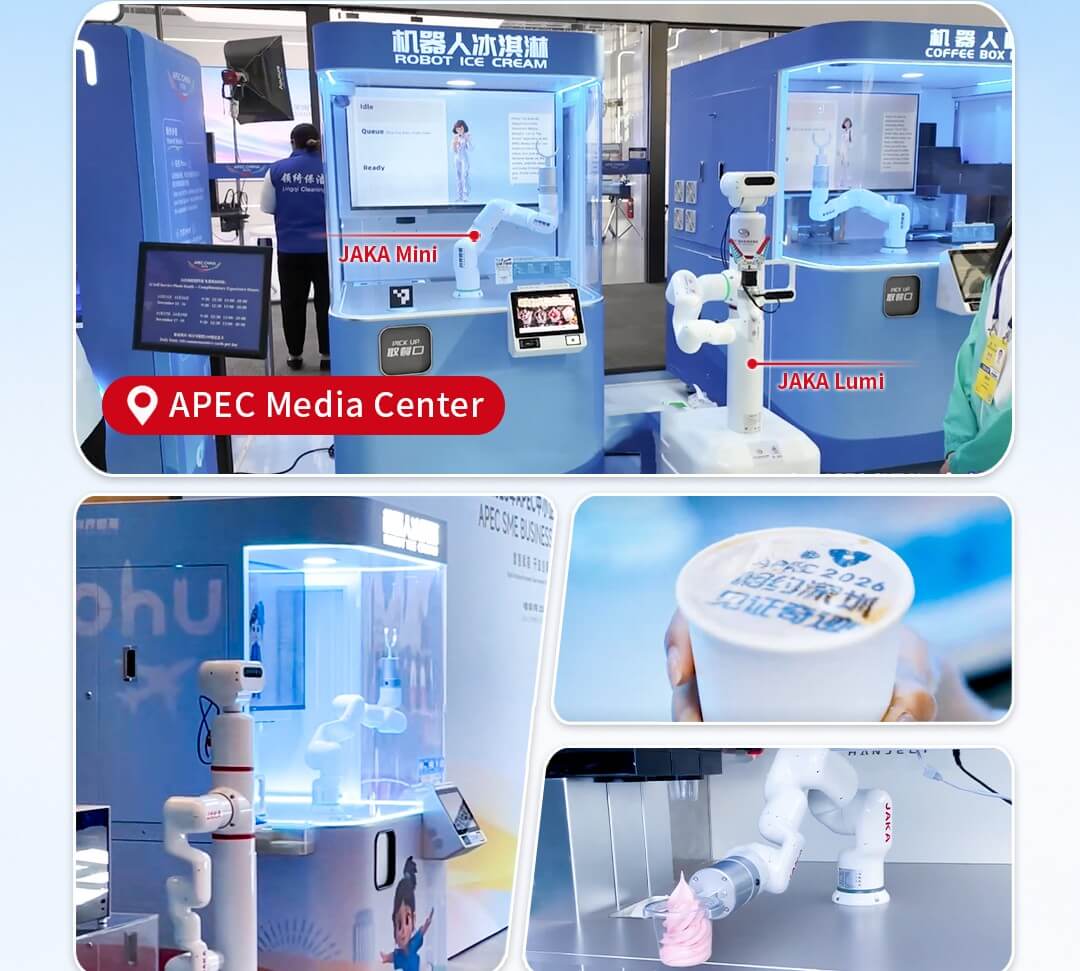
This is part of JAKA's broader effort to bring embodied intelligence into a growing range of scenarios, spanning industry, commerce, elderly care, innovation parks and public exhibition spaces.
Multi-Robot Service
At the China International Industry Fair (CIIF), the JAKA π humanoid robot took on the role of a shop manager. It received voice orders, such as “Americano, medium roast, 30 percent sugar,” and coordinated JAKA Lumi with a coffee robot to fulfill them.
Working in parallel, the robots navigated around obstacles and completed the process from order to delivery. By connecting humanoid, wheeled and fixed robots, JAKA enables tasks to be distributed and coordinated across different robot forms—turning individual actions into connected service workflows.
Elderly Care
At the Shanghai Gerontechnology Innovation Park, JAKA Lumi is being piloted for water and snack delivery. In response to requests from elderly residents or staff, it picks up items, navigates public corridors, avoids wheelchairs and pedestrians, and delivers items to designated locations.
With centimeter-level docking capability, JAKA Lumi can support frequent, lightweight tasks in elderly care settings, helping reduce routine workloads and allowing caregivers to focus more on care that requires human judgment.

Autonomous 24/7 Patrol
JAKA Lumi can also support nighttime park operations by patrolling roads, checking doors, windows and lighting, and reporting anomalies.
Equipped with LiDAR and 3D vision, the robot has a compact 518 mm-wide body and ±20 mm repeated positioning accuracy. These capabilities support autonomous patrol operations without manual recalibration, helping improve inspection efficiency and allowing security personnel to focus on risk assessment and emergency response.
Multimodal Guidance
In exhibition halls, the JAKA π humanoid robot goes beyond fixed scripts to answer spontaneous questions and identify user intent, even in noisy environments.
Its self-developed multimodal algorithms enable response times as low as 380 milliseconds, synchronize voice and gestures, and support interaction in more than 100 languages. These figures are based on JAKA laboratory tests.
Bringing Capabilities Across Scenarios
Across different robot forms and operating environments, JAKA is working to transfer and apply core capabilities—including multimodal perception, decision-making, path planning, precision operation and stable delivery.
Backed by more than a decade of robot deployment experience and tens of thousands of General Intelligent Robots deployed worldwide, JAKA continues to explore how embodied intelligence can support a broader range of real-world tasks.
This progress is also supported by JAKA's manufacturing capabilities. Recently, hundreds of JAKA π humanoid robots rolled off the production line, following the transition from EVT to mass production in just two months.
From public services to industrial and commercial operations, JAKA is bringing embodied intelligence closer to everyday use.

 Return to List


Customer Service Hotline :
400-006-2665
Whatsapp:+8618501781175
Company Email:
Company Address:
United States: 48 Wall Street, Suite 1100, New York , NY 10005
Germany: Breslauer Str. 10, 90766 Fuerth, Germany
Japan:1F, 1 - 6 - 14 Aoi, Higashi, Nagoya , Japan
Malaysia:5-G, Jalan Borealis 3, Bandar Cassia,14110 Simpang Ampat, Penang,Malaysia
China:18 Nangu Road, Minhang District, Shanghai, China
Germany: Breslauer Str. 10, 90766 Fuerth, Germany
Japan:1F, 1 - 6 - 14 Aoi, Higashi, Nagoya , Japan
Malaysia:5-G, Jalan Borealis 3, Bandar Cassia,14110 Simpang Ampat, Penang,Malaysia
China:18 Nangu Road, Minhang District, Shanghai, China
Copyright©2023JAKA Robotics Co., Ltd. All rights reserved 沪ICP备15045540号-2 沪公网安备31011202008960号

Customer Service Hotline
400-006-2665Company Email:
Company Address:
United States: 48 Wall Street, Suite 1100, New York , NY 10005
Germany: Breslauer Str. 10, 90766 Fuerth, Germany
Japan:1F, 1 - 6 - 14 Aoi, Higashi, Nagoya , Japan
Malaysia:5-G, Jalan Borealis 3, Bandar Cassia,14110 Simpang Ampat, Penang,Malaysia
China:18 Nangu Road, Minhang District, Shanghai, China
Germany: Breslauer Str. 10, 90766 Fuerth, Germany
Japan:1F, 1 - 6 - 14 Aoi, Higashi, Nagoya , Japan
Malaysia:5-G, Jalan Borealis 3, Bandar Cassia,14110 Simpang Ampat, Penang,Malaysia
China:18 Nangu Road, Minhang District, Shanghai, China


Contact Us