


'%3e%3cline%20id='直线_13422'%20data-name='直线%2013422'%20x2='29.367'%20transform='translate(23668.262%20-12026.238)%20rotate(45)'%20fill='none'%20stroke='%23000'%20stroke-linecap='round'%20stroke-width='2'/%3e%3cline%20id='直线_13423'%20data-name='直线%2013423'%20x2='29.367'%20transform='translate(23689.027%20-12026.238)%20rotate(135)'%20fill='none'%20stroke='%23000'%20stroke-linecap='round'%20stroke-width='2'/%3e%3c/g%3e%3c/svg%3e)

'%3e%3cpath%20id='路径_21753'%20data-name='路径%2021753'%20d='M25.248,22.5A8.248,8.248,0,1,0,17,14.248,8.248,8.248,0,0,0,25.248,22.5Z'%20transform='translate(-0.33%20-1.695)'%20fill='none'%20stroke='%23000'%20stroke-linecap='round'%20stroke-linejoin='round'%20stroke-width='4'/%3e%3cpath%20id='路径_21754'%20data-name='路径%2021754'%20d='M6,41.453v1.261H43.837V41.453c0-4.709,0-7.064-.916-8.862a8.409,8.409,0,0,0-3.675-3.675C37.448,28,35.093,28,30.384,28H19.453c-4.709,0-7.064,0-8.862.916a8.408,8.408,0,0,0-3.675,3.675C6,34.39,6,36.744,6,41.453Z'%20transform='translate(0%201.209)'%20fill='none'%20stroke='%23000'%20stroke-linecap='round'%20stroke-linejoin='round'%20stroke-width='4'/%3e%3c/g%3e%3c/svg%3e)


'%3e%3cpath%20id='路径_20744'%20data-name='路径%2020744'%20d='M5,19H22.665v9.762a.93.93,0,0,1-.93.93H5.93a.93.93,0,0,1-.93-.93Z'%20transform='translate(0%20-8.027)'%20fill='none'%20stroke='%23999'%20stroke-linejoin='round'%20stroke-width='1.5'/%3e%3cpath%20id='路径_20745'%20data-name='路径%2020745'%20d='M5,7.93A.93.93,0,0,1,5.93,7H21.735a.93.93,0,0,1,.93.93v4.649H5Z'%20transform='translate(0%20-1.605)'%20fill='none'%20stroke='%23999'%20stroke-linejoin='round'%20stroke-width='1.5'/%3e%3cpath%20id='路径_20746'%20data-name='路径%2020746'%20d='M16,4V7.719'%20transform='translate(-5.886)'%20fill='none'%20stroke='%23999'%20stroke-linecap='round'%20stroke-linejoin='round'%20stroke-width='1.5'/%3e%3cpath%20id='路径_20747'%20data-name='路径%2020747'%20d='M32,4V7.719'%20transform='translate(-14.449)'%20fill='none'%20stroke='%23999'%20stroke-linecap='round'%20stroke-linejoin='round'%20stroke-width='1.5'/%3e%3cpath%20id='路径_20748'%20data-name='路径%2020748'%20d='M28,34h2.789'%20transform='translate(-12.308%20-16.054)'%20fill='none'%20stroke='%23999'%20stroke-linecap='round'%20stroke-linejoin='round'%20stroke-width='1.5'/%3e%3cpath%20id='路径_20749'%20data-name='路径%2020749'%20d='M14,34h2.789'%20transform='translate(-4.816%20-16.054)'%20fill='none'%20stroke='%23999'%20stroke-linecap='round'%20stroke-linejoin='round'%20stroke-width='1.5'/%3e%3cpath%20id='路径_20750'%20data-name='路径%2020750'%20d='M28,26h2.789'%20transform='translate(-12.308%20-11.773)'%20fill='none'%20stroke='%23999'%20stroke-linecap='round'%20stroke-linejoin='round'%20stroke-width='1.5'/%3e%3cpath%20id='路径_20751'%20data-name='路径%2020751'%20d='M14,26h2.789'%20transform='translate(-4.816%20-11.773)'%20fill='none'%20stroke='%23999'%20stroke-linecap='round'%20stroke-linejoin='round'%20stroke-width='1.5'/%3e%3c/g%3e%3c/svg%3e) 2026.08.04 Blog
2026.08.04 Blog


Evaluating the financial and operational return of automated systems is essential for electronic assembly facilities targeting sustainable development. Precision-driven industries demand rigorous metrics to verify that new equipment actually improves throughput and reduces manual assembly errors. Without clear baseline measurements, manufacturing teams struggle to identify bottlenecks or calculate the true timeline of their capital investments. Developing a standardized framework of Key Performance Indicators (KPIs) allows production managers to make data-driven decisions that elevate floor efficiency.
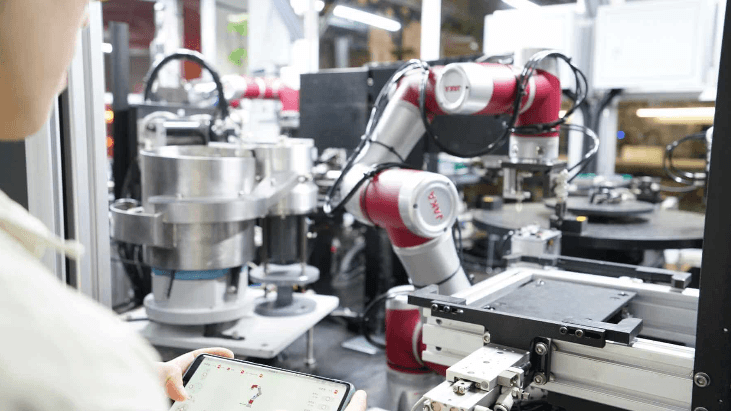
Deploying a versatile collaborative robot within delicate electronics assembly lines can quickly optimize repetitive tasks like screwdriving or circuit board testing. These compact arms integrate directly into existing human-centric workflows to stabilize production speeds and protect fragile components. Our engineering team at JAKA designs intuitive robotic solutions equipped with sensitive feedback mechanisms to assist operators with high-precision tasks. Tracking the right KPIs ensures that these advanced robotic systems deliver measurable, continuous value to the assembly floor.
Cycle Time Reduction and Throughput Consistency
Traditional electronics assembly often suffers from unpredictable throughput drops due to human fatigue, complex component handling, and varying shifting schedules. Tracking average cycle time per unit provides a clear picture of how steadily an assembly line operates over a twenty-four-hour period. Automated arms maintain a constant velocity, eliminating the minor delays that naturally accumulate during long shifts. This steady pacing stabilizes downstream packaging and testing schedules.
Quantifying the exact volume of completed assemblies per hour helps managers plan inventory and delivery schedules with much higher confidence. Integrating smart automation within high-speed robotics and manufacturing setups ensures that cycle times remain uniform regardless of external labor fluctuations. When a robotic system handles the highly repetitive picking or positioning cycles, human workers can focus on final quality checks. Consistency in cycle time translates directly to predictable, scalable daily output.
Precision Rates and Defect Reduction in Micro Assembly
Delicate processes such as applying adhesives, placing micro-connectors, or soldering circuits require sub-millimeter positioning accuracy to avoid costly material waste. Monitoring the scrap rate before and after integrating automated systems highlights the direct impact of mechanical repeatability. A minor human hand tremor can ruin a highly sensitive silicon wafer or misalign an expensive sensor housing. Automated arms eliminate this physical variability entirely.
Utilizing robotic arms with high repeatability parameters ensures that every delicate component is handled with uniform pressure and orientation. The intersection of modern robotics and manufacturing demands this level of micro-precision to reduce rework loops and raw material costs. Our JAKA Zu3 model, for example, is engineered specifically for these intricate electronics assembly tasks, offering exceptional spatial precision. Minimizing defects at the early assembly stages dramatically boosts overall yield quality.
Calculating True First Time Yield (FTY) Improvements
First Time Yield measures the percentage of electronic devices that successfully pass quality inspection after the initial assembly phase without requiring rework. Low FTY indicates systemic issues in component placement, tightening torque, or connector positioning, which drives up labor costs. Tracking this specific metric before and after deploying automation reveals hidden inefficiencies in the manual production line.
Improving FTY is particularly critical in high-volume electronics manufacturing where even a one percent failure rate leads to significant financial losses. Introducing a collaborative robot to apply precise torque or insert delicate ribbon cables dramatically lowers the probability of physical alignment errors. This steady improvement in yield rate reduces the burden on diagnostics and repair technicians down the line. Higher initial pass rates streamline the entire path from raw components to finished goods.
Measuring Space Utilization and Line Flexibility Metrics
Valuable cleanroom and factory floor real estate represents a major overhead cost that must be optimized for maximum profitability. Traditional industrial automation often demands massive protective safety enclosures, which partition the floor and restrict worker movement. Measuring the physical footprint required per work unit helps determine the spatial efficiency of the assembly line.
Compact, jointed robotic arms operate comfortably within tight physical boundaries, allowing factories to pack more process steps into existing production cells. At JAKA, we design our cobots to work safely alongside human operators without bulky guarding, maximizing the utility of every square meter. Calculating the spatial yield—defined as output volume per square meter of floor space—helps prove the economic value of flexible layouts. Compact setups enable rapid line reconfigurations as product designs evolve.
Assessing Human Labor Reallocation and Safety Indexes
Sustained productivity depends heavily on the physical health, morale, and ergonomics of the human workforce on the assembly floor. Repetitive micro-assembly tasks can cause severe repetitive strain injuries, leading to high employee absenteeism and costly turnover. Tracking the reduction in ergonomic hazard complaints and injury-related downtime provides a clear picture of workplace health improvements.
Reallocating human operators from monotonous screwdriving or testing stations to high-level process monitoring roles enhances overall job satisfaction and operational resilience. Successful integration of robotics and manufacturing technologies creates a harmonious ecosystem where physical strain is transferred entirely to automated systems. Measuring worker safety indexes alongside traditional output metrics provides a holistic view of factory floor health. Safe working conditions naturally foster a more focused, productive manufacturing team.
Return on Investment (ROI) and Total Cost of Ownership (TCO)
Long-term financial viability is the ultimate KPI that justifies the adoption of automated technology on the electronics assembly line. Calculating ROI involves balancing the initial purchase, installation, and programming costs against ongoing labor savings, reduced scrap, and increased throughput. A fast deployment cycle with minimal production downtime significantly accelerates the timeline to reach break-even profitability.
Evaluating the total cost of ownership also requires looking at energy efficiency, maintenance requirements, and the adaptability of the hardware for future product lines. Our JAKA Pro Series is designed for durable operation in demanding industrial environments, with typical power consumption specified separately for each model. A highly flexible robotic asset can be reprogrammed and redeployed to entirely new tasks as market demands shift. This long-term agility ensures the system remains a valuable asset for multiple product generations.
Conclusion
Measuring the performance of automated assembly systems through specific, data-driven KPIs is essential for sustaining competitiveness in the modern electronics sector. Relying on vague estimates of efficiency gains can lead to misallocated resources and unrealized production potential. Tracking metrics like cycle time consistency, defect reduction, and spatial efficiency provides a clear, objective roadmap for operational growth.
Adopting a systematic measurement approach empowers facility managers to optimize human-robot workflows with complete confidence. Through continuous monitoring of these critical indices, manufacturing teams can refine their automated processes to achieve the highest possible standard of quality. We remain focused on providing the highly precise, flexible robotic tools necessary to help electronics manufacturers worldwide meet their strict operational goals. Committing to rigorous KPI tracking ensures that automated investments continue to yield robust returns far into the future.
'%3e%3cpath%20id='路径_17618'%20data-name='路径%2017618'%20d='M10.031,8,6,11.455l4.031,4.031'%20fill='none'%20stroke='%23333'%20stroke-linecap='round'%20stroke-linejoin='round'%20stroke-width='2'/%3e%3cpath%20id='路径_17619'%20data-name='路径%2017619'%20d='M6,14H19.24a7.486,7.486,0,1,1,0,14.971H9.454'%20transform='translate(0%20-2.545)'%20fill='none'%20stroke='%23333'%20stroke-linecap='round'%20stroke-linejoin='round'%20stroke-width='2'/%3e%3c/g%3e%3c/svg%3e)
'%3e%3cpath%20id='路径_17618'%20data-name='路径%2017618'%20d='M10.031,8,6,11.455l4.031,4.031'%20fill='none'%20stroke='%23fff'%20stroke-linecap='round'%20stroke-linejoin='round'%20stroke-width='2'/%3e%3cpath%20id='路径_17619'%20data-name='路径%2017619'%20d='M6,14H19.24a7.486,7.486,0,1,1,0,14.971H9.454'%20transform='translate(0%20-2.545)'%20fill='none'%20stroke='%23fff'%20stroke-linecap='round'%20stroke-linejoin='round'%20stroke-width='2'/%3e%3c/g%3e%3c/svg%3e) Return to List
Return to List


Germany: Breslauer Str. 10, 90766 Fuerth, Germany
Japan:1F, 1 - 6 - 14 Aoi, Higashi, Nagoya , Japan
Malaysia:5-G, Jalan Borealis 3, Bandar Cassia,14110 Simpang Ampat, Penang,Malaysia
China:18 Nangu Road, Minhang District, Shanghai, China
'%3e%3ccircle%20id='椭圆_7060'%20data-name='椭圆%207060'%20cx='50'%20cy='50'%20r='50'%20transform='translate(134%209657)'%20fill='%23d80c1e'/%3e%3cpath%20id='路径_21623'%20data-name='路径%2021623'%20d='M947.11,3321.132s-4.227,8.162,4.833,24.7c.065.116.129.23.195.346s.124.234.187.354c9.06,16.532,18.214,17.362,18.214,17.362a4.8,4.8,0,0,0,2.246-.177,17.018,17.018,0,0,0,4.229-2.687c1.79-1.639.384-5.317-.541-7.009-1.876-3.422-4.162-4.65-5.447-4.225-.577.188-3.1,1.7-3.1,1.7a2.855,2.855,0,0,1-1.86.213s-3.357-.941-7.792-8.892c-4.309-8.01-3.3-11.347-3.3-11.347a2.854,2.854,0,0,1,1.182-1.455s3.069-1.675,3.1-1.7c1.229-.863.555-4.1-.63-6.864a6.434,6.434,0,0,0-3.163-3.754c-2.256-1.158-7.477.768-8.349,3.436Z'%20transform='translate(-778%206368.353)'%20fill='%23fff'/%3e%3c/g%3e%3c/svg%3e)
Germany: Breslauer Str. 10, 90766 Fuerth, Germany
Japan:1F, 1 - 6 - 14 Aoi, Higashi, Nagoya , Japan
Malaysia:5-G, Jalan Borealis 3, Bandar Cassia,14110 Simpang Ampat, Penang,Malaysia
China:18 Nangu Road, Minhang District, Shanghai, China


'%3e%3cpath%20id='路径_21594'%20data-name='路径%2021594'%20d='M-993.748,3818.961h0a8.127,8.127,0,1,0-16.25,0'%20transform='translate(-0.958%200)'%20fill='none'%20stroke='%23d80c1e'%20stroke-linecap='round'%20stroke-linejoin='round'%20stroke-width='1'/%3e%3cpath%20id='路径_21595'%20data-name='路径%2021595'%20d='M-987.315,3834.607h0a6.421,6.421,0,0,1-6.421,6.421h-.153'%20transform='translate(-7.391%20-9.576)'%20fill='none'%20stroke='%23d80c1e'%20stroke-linecap='round'%20stroke-linejoin='round'%20stroke-width='1'/%3e%3crect%20id='矩形_48952'%20data-name='矩形%2048952'%20width='2.883'%20height='6.026'%20rx='1.442'%20transform='translate(-996.148%203818.961)'%20fill='none'%20stroke='%23d80c1e'%20stroke-linecap='round'%20stroke-linejoin='round'%20stroke-width='1'/%3e%3crect%20id='矩形_48953'%20data-name='矩形%2048953'%20width='2.883'%20height='6.026'%20rx='1.442'%20transform='translate(-1012.397%203818.961)'%20fill='none'%20stroke='%23d80c1e'%20stroke-linecap='round'%20stroke-linejoin='round'%20stroke-width='1'/%3e%3crect%20id='矩形_48954'%20data-name='矩形%2048954'%20width='3.07'%20height='2.291'%20rx='1.146'%20transform='translate(-1004.35%203830.306)'%20fill='none'%20stroke='%23d80c1e'%20stroke-linecap='round'%20stroke-linejoin='round'%20stroke-width='1'/%3e%3c/g%3e%3c/svg%3e)
'%3e%3cpath%20id='路径_21594'%20data-name='路径%2021594'%20d='M-993.748,3818.961h0a8.127,8.127,0,1,0-16.25,0'%20transform='translate(-0.958%200)'%20fill='none'%20stroke='%23fff'%20stroke-linecap='round'%20stroke-linejoin='round'%20stroke-width='1'/%3e%3cpath%20id='路径_21595'%20data-name='路径%2021595'%20d='M-987.315,3834.607h0a6.421,6.421,0,0,1-6.421,6.421h-.153'%20transform='translate(-7.391%20-9.576)'%20fill='none'%20stroke='%23fff'%20stroke-linecap='round'%20stroke-linejoin='round'%20stroke-width='1'/%3e%3crect%20id='矩形_48952'%20data-name='矩形%2048952'%20width='2.883'%20height='6.026'%20rx='1.442'%20transform='translate(-996.148%203818.961)'%20fill='none'%20stroke='%23fff'%20stroke-linecap='round'%20stroke-linejoin='round'%20stroke-width='1'/%3e%3crect%20id='矩形_48953'%20data-name='矩形%2048953'%20width='2.883'%20height='6.026'%20rx='1.442'%20transform='translate(-1012.397%203818.961)'%20fill='none'%20stroke='%23fff'%20stroke-linecap='round'%20stroke-linejoin='round'%20stroke-width='1'/%3e%3crect%20id='矩形_48954'%20data-name='矩形%2048954'%20width='3.07'%20height='2.291'%20rx='1.146'%20transform='translate(-1004.35%203830.306)'%20fill='none'%20stroke='%23fff'%20stroke-linecap='round'%20stroke-linejoin='round'%20stroke-width='1'/%3e%3c/g%3e%3c/svg%3e)


'%3e%3cpath%20id='路径_21593'%20data-name='路径%2021593'%20d='M-971.813,3958.813l5.517-5.517,5.517,5.517'%20fill='none'%20stroke='%23d80c1e'%20stroke-linecap='round'%20stroke-linejoin='round'%20stroke-width='1'/%3e%3cline%20id='直线_13976'%20data-name='直线%2013976'%20y2='15.981'%20transform='translate(-966.296%203953.296)'%20fill='none'%20stroke='%23d80c1e'%20stroke-linecap='round'%20stroke-linejoin='round'%20stroke-width='1'/%3e%3cline%20id='直线_13977'%20data-name='直线%2013977'%20x2='8.519'%20transform='translate(-970.556%203952.778)'%20fill='none'%20stroke='%23d80c1e'%20stroke-linecap='round'%20stroke-linejoin='round'%20stroke-width='1'/%3e%3c/g%3e%3c/svg%3e)
'%3e%3cpath%20id='路径_21593'%20data-name='路径%2021593'%20d='M-971.813,3958.813l5.517-5.517,5.517,5.517'%20fill='none'%20stroke='%23fff'%20stroke-linecap='round'%20stroke-linejoin='round'%20stroke-width='1'/%3e%3cline%20id='直线_13976'%20data-name='直线%2013976'%20y2='15.981'%20transform='translate(-966.296%203953.296)'%20fill='none'%20stroke='%23fff'%20stroke-linecap='round'%20stroke-linejoin='round'%20stroke-width='1'/%3e%3cline%20id='直线_13977'%20data-name='直线%2013977'%20x2='8.519'%20transform='translate(-970.556%203952.778)'%20fill='none'%20stroke='%23fff'%20stroke-linecap='round'%20stroke-linejoin='round'%20stroke-width='1'/%3e%3c/g%3e%3c/svg%3e)