



'%3e%3cline%20id='直线_13422'%20data-name='直线%2013422'%20x2='29.367'%20transform='translate(23668.262%20-12026.238)%20rotate(45)'%20fill='none'%20stroke='%23000'%20stroke-linecap='round'%20stroke-width='2'/%3e%3cline%20id='直线_13423'%20data-name='直线%2013423'%20x2='29.367'%20transform='translate(23689.027%20-12026.238)%20rotate(135)'%20fill='none'%20stroke='%23000'%20stroke-linecap='round'%20stroke-width='2'/%3e%3c/g%3e%3c/svg%3e)
'%3e%3cpath%20id='路径_21753'%20data-name='路径%2021753'%20d='M25.248,22.5A8.248,8.248,0,1,0,17,14.248,8.248,8.248,0,0,0,25.248,22.5Z'%20transform='translate(-0.33%20-1.695)'%20fill='none'%20stroke='%23000'%20stroke-linecap='round'%20stroke-linejoin='round'%20stroke-width='4'/%3e%3cpath%20id='路径_21754'%20data-name='路径%2021754'%20d='M6,41.453v1.261H43.837V41.453c0-4.709,0-7.064-.916-8.862a8.409,8.409,0,0,0-3.675-3.675C37.448,28,35.093,28,30.384,28H19.453c-4.709,0-7.064,0-8.862.916a8.408,8.408,0,0,0-3.675,3.675C6,34.39,6,36.744,6,41.453Z'%20transform='translate(0%201.209)'%20fill='none'%20stroke='%23000'%20stroke-linecap='round'%20stroke-linejoin='round'%20stroke-width='4'/%3e%3c/g%3e%3c/svg%3e)


'%3e%3cpath%20id='路径_20744'%20data-name='路径%2020744'%20d='M5,19H22.665v9.762a.93.93,0,0,1-.93.93H5.93a.93.93,0,0,1-.93-.93Z'%20transform='translate(0%20-8.027)'%20fill='none'%20stroke='%23999'%20stroke-linejoin='round'%20stroke-width='1.5'/%3e%3cpath%20id='路径_20745'%20data-name='路径%2020745'%20d='M5,7.93A.93.93,0,0,1,5.93,7H21.735a.93.93,0,0,1,.93.93v4.649H5Z'%20transform='translate(0%20-1.605)'%20fill='none'%20stroke='%23999'%20stroke-linejoin='round'%20stroke-width='1.5'/%3e%3cpath%20id='路径_20746'%20data-name='路径%2020746'%20d='M16,4V7.719'%20transform='translate(-5.886)'%20fill='none'%20stroke='%23999'%20stroke-linecap='round'%20stroke-linejoin='round'%20stroke-width='1.5'/%3e%3cpath%20id='路径_20747'%20data-name='路径%2020747'%20d='M32,4V7.719'%20transform='translate(-14.449)'%20fill='none'%20stroke='%23999'%20stroke-linecap='round'%20stroke-linejoin='round'%20stroke-width='1.5'/%3e%3cpath%20id='路径_20748'%20data-name='路径%2020748'%20d='M28,34h2.789'%20transform='translate(-12.308%20-16.054)'%20fill='none'%20stroke='%23999'%20stroke-linecap='round'%20stroke-linejoin='round'%20stroke-width='1.5'/%3e%3cpath%20id='路径_20749'%20data-name='路径%2020749'%20d='M14,34h2.789'%20transform='translate(-4.816%20-16.054)'%20fill='none'%20stroke='%23999'%20stroke-linecap='round'%20stroke-linejoin='round'%20stroke-width='1.5'/%3e%3cpath%20id='路径_20750'%20data-name='路径%2020750'%20d='M28,26h2.789'%20transform='translate(-12.308%20-11.773)'%20fill='none'%20stroke='%23999'%20stroke-linecap='round'%20stroke-linejoin='round'%20stroke-width='1.5'/%3e%3cpath%20id='路径_20751'%20data-name='路径%2020751'%20d='M14,26h2.789'%20transform='translate(-4.816%20-11.773)'%20fill='none'%20stroke='%23999'%20stroke-linecap='round'%20stroke-linejoin='round'%20stroke-width='1.5'/%3e%3c/g%3e%3c/svg%3e) 2026.03.09 Blog
2026.03.09 Blog


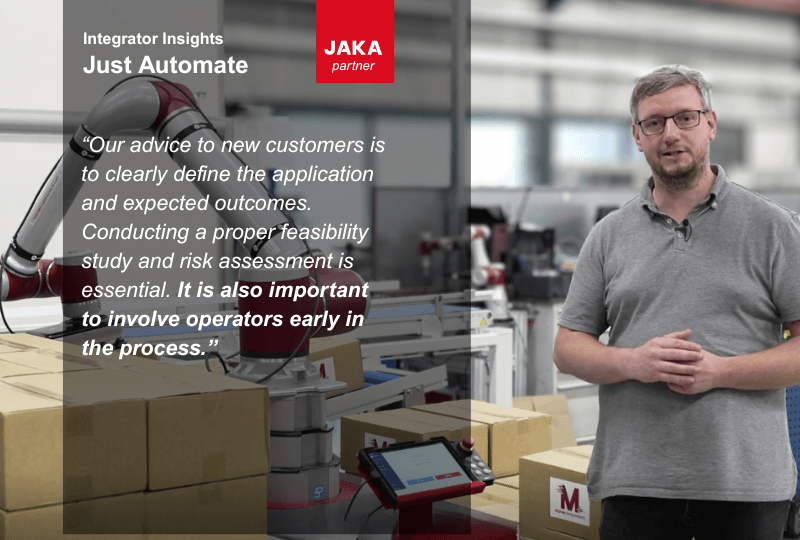
In our Integrator Insights series, we speak with JAKA partners around the world about automation trends, customer challenges, and real-world cobot applications.
This time, we spoke with Pieter Treffers, Business Development Manager at Just Automate, the core reseller and integrator of JAKA Robotics in the Benelux region. He shares insights on market trends, common misconceptions about cobots, and how collaborative automation is helping manufacturers become more flexible and efficient.
Can you briefly introduce Just Automate?
We are the core reseller of JAKA Robotics in the Benelux, helping companies integrate advanced collaborative robots to boost efficiency, reduce costs, and automate repetitive tasks.
At Just Automate, we focus on bringing smart automation solutions to businesses, enabling them to innovate faster and work smarter. Our core focus is on industrial automation and collaborative robotic solutions, particularly for small and medium-sized enterprises (SMEs).
Our customers are mainly from industries such as manufacturing (OEM), food & beverage, plastics, metal processing, and packaging & logistics.
The most frequent applications customers approach us for include palletizing, machine tending, and packaging. Many of our customers seek flexible, scalable solutions that can be implemented without major production disruptions.
What are the main challenges your customers face today?
Across industries, our customers face several key challenges.
Labor shortages and difficulty finding skilled workers remain one of the biggest issues. At the same time, companies are facing increasing production costs while being required to deliver higher product quality and consistency.
Another challenge is the need for greater flexibility due to smaller batch sizes and more customized production requirements. Many companies are also under pressure to increase productivity without expanding their available floor space.
These challenges are particularly significant in high-mix, low-volume production environments.
How do you see the role of automation in manufacturing?
Automation plays a crucial role in addressing these challenges.
Cobots help reduce dependency on manual labor while improving consistency and quality. They also enable companies to operate production processes continuously, including the possibility of 24/7 operation.
Because cobots are easy to program and redeploy, they provide the flexibility modern manufacturers require. This allows companies to increase productivity without making major infrastructure changes.
What are the most common misconceptions about cobots?
We frequently encounter several misconceptions about collaborative robots.
Some customers believe cobots are completely risk-free and require no safety assessment. Others assume they are only suitable for small or lightweight tasks, or that they are less durable than traditional industrial robots.
Another common misunderstanding is that implementation is overly complex.
In practice, we explain that cobots are safe when properly integrated and risk-assessed, and that they can handle a wide range of industrial applications.
What are common pitfalls when implementing cobots?
Companies often face several challenges when starting their automation journey.
Common issues include underestimating the importance of proper application analysis, insufficient risk assessment, unrealistic ROI expectations, and a lack of internal project ownership.
Our advice to new customers is to clearly define the application and expected outcomes. Conducting a proper feasibility study and risk assessment is essential. It is also important to involve operators early in the process and start with a manageable pilot project.
Working closely with an experienced integrator ensures a smoother implementation, faster ROI, and long-term success.
How would you describe the current automation market in your country?
The automation market in the Benelux region is growing steadily, mainly driven by labor shortages and rising cost pressure.
Customer awareness of automation is increasing. However, awareness of collaborative robots specifically is still developing.
While many customers are familiar with traditional industrial robots, the term “cobot” is not always fully understood. Education and demonstration therefore remain important parts of our sales process.
Why does Just Automate partner with JAKA?
We have been working with JAKA Robotics since 2021.
What convinced us to include JAKA in our portfolio was the competitive performance-to-price ratio, the advanced technology combined with a compact design, and the ease of programming.
We also value the strong technical support and the reliable product quality.
JAKA’s innovation in collaborative robotics aligns very well with our strategy of delivering flexible automation solutions.
Can you share a concrete project example?
We most commonly use JAKA cobots for palletizing, machine tending, packaging, assembly operations, and pick-and-place applications.
One typical project involved automating a manual palletizing process for a spritz producer. Previously, operators manually stacked boxes onto pallets, which caused unnecessary production downtime and physically demanding work.
After implementing a JAKA cobot solution, productivity increased by over 30%, and the manual workload was eliminated. Instead of requiring two operators, one operator can now manage the entire production line.
The customer achieved a return on investment within 12 months.
Customers particularly appreciate the flexibility to redeploy the cobot to other tasks whenever needed.
When do you recommend cobots over industrial robots?
We recommend cobots because they are easy to integrate into existing production lines and require a lower upfront investment compared to traditional robot cells.
They also have a compact footprint, can be manually repositioned when needed, and allow for faster deployment. In addition, cobots enable safe collaboration with human workers.
Compared to traditional industrial robots, cobots often require less safety fencing depending on the risk assessment, are easier to program, and are particularly well suited for SMEs entering automation for the first time.
Key Takeaways
1) Manufacturers in the Benelux face increasing labor shortages and cost pressure.
2) Cobots provide flexible automation without major infrastructure changes.
3) Education is still important, as many companies are not yet fully familiar with cobots.
4) Proper application analysis and risk assessment are critical for successful implementation.
5) Real-world applications such as palletizing and machine tending can deliver fast ROI.
'%3e%3cpath%20id='路径_17618'%20data-name='路径%2017618'%20d='M10.031,8,6,11.455l4.031,4.031'%20fill='none'%20stroke='%23333'%20stroke-linecap='round'%20stroke-linejoin='round'%20stroke-width='2'/%3e%3cpath%20id='路径_17619'%20data-name='路径%2017619'%20d='M6,14H19.24a7.486,7.486,0,1,1,0,14.971H9.454'%20transform='translate(0%20-2.545)'%20fill='none'%20stroke='%23333'%20stroke-linecap='round'%20stroke-linejoin='round'%20stroke-width='2'/%3e%3c/g%3e%3c/svg%3e)
'%3e%3cpath%20id='路径_17618'%20data-name='路径%2017618'%20d='M10.031,8,6,11.455l4.031,4.031'%20fill='none'%20stroke='%23fff'%20stroke-linecap='round'%20stroke-linejoin='round'%20stroke-width='2'/%3e%3cpath%20id='路径_17619'%20data-name='路径%2017619'%20d='M6,14H19.24a7.486,7.486,0,1,1,0,14.971H9.454'%20transform='translate(0%20-2.545)'%20fill='none'%20stroke='%23fff'%20stroke-linecap='round'%20stroke-linejoin='round'%20stroke-width='2'/%3e%3c/g%3e%3c/svg%3e) Return to List
Return to List


90766 Fuerth, Germany
'%3e%3ccircle%20id='椭圆_7060'%20data-name='椭圆%207060'%20cx='50'%20cy='50'%20r='50'%20transform='translate(134%209657)'%20fill='%23d80c1e'/%3e%3cpath%20id='路径_21623'%20data-name='路径%2021623'%20d='M947.11,3321.132s-4.227,8.162,4.833,24.7c.065.116.129.23.195.346s.124.234.187.354c9.06,16.532,18.214,17.362,18.214,17.362a4.8,4.8,0,0,0,2.246-.177,17.018,17.018,0,0,0,4.229-2.687c1.79-1.639.384-5.317-.541-7.009-1.876-3.422-4.162-4.65-5.447-4.225-.577.188-3.1,1.7-3.1,1.7a2.855,2.855,0,0,1-1.86.213s-3.357-.941-7.792-8.892c-4.309-8.01-3.3-11.347-3.3-11.347a2.854,2.854,0,0,1,1.182-1.455s3.069-1.675,3.1-1.7c1.229-.863.555-4.1-.63-6.864a6.434,6.434,0,0,0-3.163-3.754c-2.256-1.158-7.477.768-8.349,3.436Z'%20transform='translate(-778%206368.353)'%20fill='%23fff'/%3e%3c/g%3e%3c/svg%3e)
90766 Fuerth, Germany


'%3e%3cpath%20id='路径_21593'%20data-name='路径%2021593'%20d='M-971.813,3958.813l5.517-5.517,5.517,5.517'%20fill='none'%20stroke='%23d80c1e'%20stroke-linecap='round'%20stroke-linejoin='round'%20stroke-width='1'/%3e%3cline%20id='直线_13976'%20data-name='直线%2013976'%20y2='15.981'%20transform='translate(-966.296%203953.296)'%20fill='none'%20stroke='%23d80c1e'%20stroke-linecap='round'%20stroke-linejoin='round'%20stroke-width='1'/%3e%3cline%20id='直线_13977'%20data-name='直线%2013977'%20x2='8.519'%20transform='translate(-970.556%203952.778)'%20fill='none'%20stroke='%23d80c1e'%20stroke-linecap='round'%20stroke-linejoin='round'%20stroke-width='1'/%3e%3c/g%3e%3c/svg%3e)
'%3e%3cpath%20id='路径_21593'%20data-name='路径%2021593'%20d='M-971.813,3958.813l5.517-5.517,5.517,5.517'%20fill='none'%20stroke='%23fff'%20stroke-linecap='round'%20stroke-linejoin='round'%20stroke-width='1'/%3e%3cline%20id='直线_13976'%20data-name='直线%2013976'%20y2='15.981'%20transform='translate(-966.296%203953.296)'%20fill='none'%20stroke='%23fff'%20stroke-linecap='round'%20stroke-linejoin='round'%20stroke-width='1'/%3e%3cline%20id='直线_13977'%20data-name='直线%2013977'%20x2='8.519'%20transform='translate(-970.556%203952.778)'%20fill='none'%20stroke='%23fff'%20stroke-linecap='round'%20stroke-linejoin='round'%20stroke-width='1'/%3e%3c/g%3e%3c/svg%3e)