



'%3e%3cline%20id='直线_13422'%20data-name='直线%2013422'%20x2='29.367'%20transform='translate(23668.262%20-12026.238)%20rotate(45)'%20fill='none'%20stroke='%23000'%20stroke-linecap='round'%20stroke-width='2'/%3e%3cline%20id='直线_13423'%20data-name='直线%2013423'%20x2='29.367'%20transform='translate(23689.027%20-12026.238)%20rotate(135)'%20fill='none'%20stroke='%23000'%20stroke-linecap='round'%20stroke-width='2'/%3e%3c/g%3e%3c/svg%3e)
'%3e%3cpath%20id='路径_21753'%20data-name='路径%2021753'%20d='M25.248,22.5A8.248,8.248,0,1,0,17,14.248,8.248,8.248,0,0,0,25.248,22.5Z'%20transform='translate(-0.33%20-1.695)'%20fill='none'%20stroke='%23000'%20stroke-linecap='round'%20stroke-linejoin='round'%20stroke-width='4'/%3e%3cpath%20id='路径_21754'%20data-name='路径%2021754'%20d='M6,41.453v1.261H43.837V41.453c0-4.709,0-7.064-.916-8.862a8.409,8.409,0,0,0-3.675-3.675C37.448,28,35.093,28,30.384,28H19.453c-4.709,0-7.064,0-8.862.916a8.408,8.408,0,0,0-3.675,3.675C6,34.39,6,36.744,6,41.453Z'%20transform='translate(0%201.209)'%20fill='none'%20stroke='%23000'%20stroke-linecap='round'%20stroke-linejoin='round'%20stroke-width='4'/%3e%3c/g%3e%3c/svg%3e)


'%3e%3cpath%20id='路径_20744'%20data-name='路径%2020744'%20d='M5,19H22.665v9.762a.93.93,0,0,1-.93.93H5.93a.93.93,0,0,1-.93-.93Z'%20transform='translate(0%20-8.027)'%20fill='none'%20stroke='%23999'%20stroke-linejoin='round'%20stroke-width='1.5'/%3e%3cpath%20id='路径_20745'%20data-name='路径%2020745'%20d='M5,7.93A.93.93,0,0,1,5.93,7H21.735a.93.93,0,0,1,.93.93v4.649H5Z'%20transform='translate(0%20-1.605)'%20fill='none'%20stroke='%23999'%20stroke-linejoin='round'%20stroke-width='1.5'/%3e%3cpath%20id='路径_20746'%20data-name='路径%2020746'%20d='M16,4V7.719'%20transform='translate(-5.886)'%20fill='none'%20stroke='%23999'%20stroke-linecap='round'%20stroke-linejoin='round'%20stroke-width='1.5'/%3e%3cpath%20id='路径_20747'%20data-name='路径%2020747'%20d='M32,4V7.719'%20transform='translate(-14.449)'%20fill='none'%20stroke='%23999'%20stroke-linecap='round'%20stroke-linejoin='round'%20stroke-width='1.5'/%3e%3cpath%20id='路径_20748'%20data-name='路径%2020748'%20d='M28,34h2.789'%20transform='translate(-12.308%20-16.054)'%20fill='none'%20stroke='%23999'%20stroke-linecap='round'%20stroke-linejoin='round'%20stroke-width='1.5'/%3e%3cpath%20id='路径_20749'%20data-name='路径%2020749'%20d='M14,34h2.789'%20transform='translate(-4.816%20-16.054)'%20fill='none'%20stroke='%23999'%20stroke-linecap='round'%20stroke-linejoin='round'%20stroke-width='1.5'/%3e%3cpath%20id='路径_20750'%20data-name='路径%2020750'%20d='M28,26h2.789'%20transform='translate(-12.308%20-11.773)'%20fill='none'%20stroke='%23999'%20stroke-linecap='round'%20stroke-linejoin='round'%20stroke-width='1.5'/%3e%3cpath%20id='路径_20751'%20data-name='路径%2020751'%20d='M14,26h2.789'%20transform='translate(-4.816%20-11.773)'%20fill='none'%20stroke='%23999'%20stroke-linecap='round'%20stroke-linejoin='round'%20stroke-width='1.5'/%3e%3c/g%3e%3c/svg%3e) 2026.02.10 Blog
2026.02.10 Blog


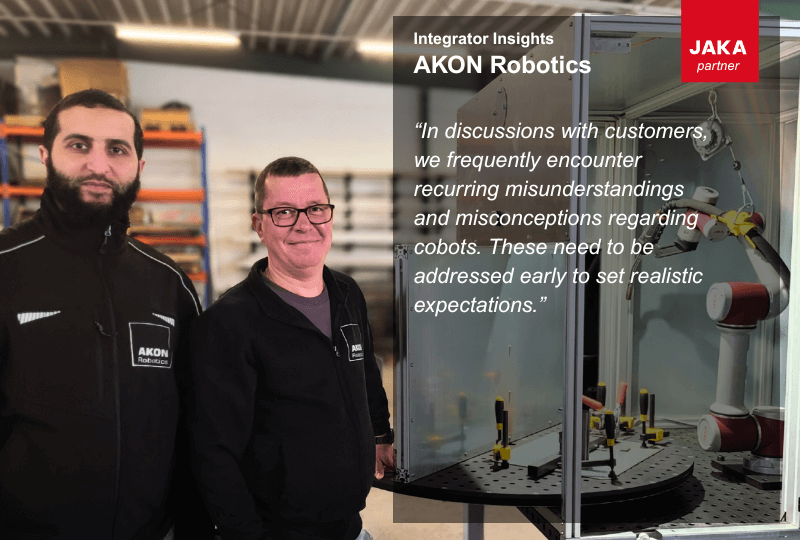
AKON Robotics is a Bremen-based system integrator specializing in custom, CE-compliant automation solutions. We spoke with Ihsen Ben Gaied, Design Engineer at AKON Robotics, about current manufacturing challenges, the role of cobots, common misconceptions, and what successful automation really requires.
Can you briefly introduce AKON Robotics?
AKON Robotics is a specialized engineering and system integration company focused on automation technology, robotics, gripper systems, and CE-compliant custom machinery.
As a system integrator, we design and implement holistic, process-specific automation solutions. This includes robot-assisted welding, palletizing and depalletizing, custom assembly lines, and gripper and tooling technology—including lightweight and 3D-printed solutions. We guide projects through the full lifecycle, from concept and mechanical design to CE-compliant risk assessment and implementation, ensuring every system meets industry standards.
Our customers are primarily medium-sized manufacturers and machinery builders who need to boost quality, productivity, and flexibility, often under tight economic constraints.
What are the main challenges your customers face today?
Across industries, we see very similar challenges. One of the most pressing issues is the ongoing shortage of skilled labor, particularly in welding. At the same time, manufacturers face rising expectations for consistent, documentable quality, stable and reproducible processes, and compliance with safety and regulatory requirements.
Production environments are increasingly shaped by small to medium batch sizes, high product variety, and short-term order changes. Under these conditions, classic automation solutions often struggle to remain economically viable.
Many companies also lack clarity when choosing between cobots, industrial robots, or hybrid solutions.Realistic assessments of cycle times, safety requirements, peripheral equipment, and total system costs are often missing—yet these factors are critical for long-term, future-proof production.
How do you see the role of automation in manufacturing?
Automation is not an end in itself. It’s a strategic tool to:
- Stabilize processes
- Ensure reproducible quality
- Decouple quality from individual operators
In welding, for example, automation ensures consistent results, reduces scrap and rework, and frees skilled workers for higher-value tasks.
Cobots play a complementary role, especially when flexibility is required, components are variant-rich,and automation is introduced step by step.
However, success always depends on viewing automation as a complete system, including fixtures, tooling, software, safety concepts, and CE compliance.
What are the most common misconceptions about cobots?
One common assumption, that we frequently encounter, is that cobots are automatically safe due to built-in collision detection.In reality, safety depends on the entire system, including tools, workpieces, and the surrounding environment.
Another misconception is that cobots can replace industrial robots in all applications.While cobots offer flexibility and ease of use, they are limited in speed, payload, and reach. Programming is also often underestimated—intuitive interfaces help, but professional integration expertise is still required.
Finally, cobots are often perceived as a low-cost solution. When safety technology, peripherals, and CE documentation are included, total system costs can approach those of small industrial robot cells. Addressing these points early helps set realistic expectations and ensures economically viable automation projects.
What are common pitfalls when implementing cobots?
When introducing cobots, companies often encounter typical challenges that can delay or complicate successful implementation. Based on our experience, these pitfalls can be grouped into several key areas.
1. Insufficient process analysis: Cobots are often deployed based on simplified assumptions without considering the entire production process. It is crucial to evaluate part variety, cycle times, handling requirements, and safety considerations before installing a system.
2. Underestimating safety and CE requirements: While cobots are inherently safe, these safety features only apply to the bare robot without end-effectors. Applications such as welding, palletizing, or handling hot or hazardous parts require CE-compliant safety measures, including protective enclosures, light barriers, extraction systems, and a full risk assessment.
3. Poor integration of peripherals: Cobots perform best as part of a complete system that includes grippers, tools, rotary tables, or welding power sources. Insufficient integration can lead to quality issues, longer cycle times, or system failures.
4. Unrealistic expectations for speed and payload: Cobots are designed for flexibility and precision, not maximum speed or heavy loads. Companies must adapt processes to the physical limitations of the cobots to avoid overloading or safety risks
5. Lack of operator training: Although cobots are easier to program than traditional robots, proper operator training is essential for safe and efficient process execution. Without adequate training, errors in operation or programming can occur.
How would you describe the current automation market in Germany?
The automation market in Germany is generally highly developed and characterized by a strong technical standard. At the same time, it is undergoing significant change, driven primarily by skilled labor shortages, rising cost structures, and increasing requirements for quality, safety, and documentation.
The term “cobot” is now widely recognized and is frequently associated with easy integration, a low entry barrier, and high flexibility. These expectations make cobots particularly attractive for companies looking to enter automation quickly and with limited upfront investment.
In practice, however, cobots are often perceived as a universal solution, without fully considering the technical and regulatory framework. Important aspects such as collaborative robotics safety concepts (MRK), risk assessments, required peripheral equipment—such as safety enclosures, extraction systems, and fixturing—as well as real performance limits in terms of speed and payload are frequently underestimated.
From our perspective, the market is therefore moving toward a more differentiated approach. Cobots are no longer deployed indiscriminately but used in a targeted way where they are both technically viable and economically justified. At the same time, traditional industrial robots remain indispensable for many applications.
Why does AKON Robotics partner with JAKA?
JAKA cobots fit very well into our system-based approach. Key reasons include:
- Easy integration into existing or new production cells
- Robust and precise hardware
- Intuitive operation for operators with limited robotics experience
- Open interfaces for grippers, welding power sources, and software
- Strong price-performance ratio for medium-batch, high-mix production
This allows us to deliver safe, CE-compliant, and economically sound automation systems.
Can you share a concrete project example?
We deploy JAKA cobots specifically in areas where flexibility, safety, and rapid ROI are the primary concerns. One example is integrating a JAKA S cobot into our welding cell (ASK-100-CB).
The welding cell is built to automate welding of high-mix components in small batch sizes. It combines the JAKA cobot with Kemppi welding system and also includes an integrated rotary table.
This solution brings consistent weld quality, CE-compliant safety with protective housing, short setup times and fast ROI, as well as flexibility for changing components.
After implementation of JAKA cobot solutions, our customers frequently report reduction of scrap and rework; increased productivity without additional skilled labor; improved ergonomic conditions for operators; as well as faster ROI thanks to modular, ready-to-use systems (“Plug & Weld”).
Integrating JAKA cobots into our automation solutions enables tailored, fully coordinated systems, where robot, peripherals, software, and safety concepts are perfectly aligned – a decisive advantage over standalone robots or uncoordinated solutions.
When do you recommend cobots over industrial robots?
We recommend automation with cobots because they offer clear technical and economic advantages, especially where flexibility, safety, and fast integration are required.
Cobots can be easily reprogrammed for changing components or small batch sizes, making them well suited for high-mix, low-volume production. Their compact design and open interfaces also enable quick integration into existing production lines, including peripherals such as grippers, tools, or welding power sources.
A further advantage is safety in human-robot collaboration. Integrated sensors as well as speed and force limitations allow cobots to operate in close proximity to personnel, while additional safety measures ensure CE-compliant operation.
Combined with intuitive user interfaces and simple programming, cobots require relatively little training effort and allow for rapid deployment. Economically, short setup times and flexible use result in a fast ROI, even for small to medium batch sizes.
Cobots are not a universal replacement for industrial robots, which remain essential for high-speed, heavy-payload, and large-volume applications. Instead, they serve as a flexible and efficient complement that helps make production processes safer, more adaptable, and economically viable.
Key Takeaways
1) Successful automation requires holistic system design
2) Cobots excel in flexible, high-mix, low-volume environments
3) Safety and CE compliance must be planned from the start
4) Skilled labor shortages make automation a necessity
5) Experienced system integrators are key to long-term success
'%3e%3cpath%20id='路径_17618'%20data-name='路径%2017618'%20d='M10.031,8,6,11.455l4.031,4.031'%20fill='none'%20stroke='%23333'%20stroke-linecap='round'%20stroke-linejoin='round'%20stroke-width='2'/%3e%3cpath%20id='路径_17619'%20data-name='路径%2017619'%20d='M6,14H19.24a7.486,7.486,0,1,1,0,14.971H9.454'%20transform='translate(0%20-2.545)'%20fill='none'%20stroke='%23333'%20stroke-linecap='round'%20stroke-linejoin='round'%20stroke-width='2'/%3e%3c/g%3e%3c/svg%3e)
'%3e%3cpath%20id='路径_17618'%20data-name='路径%2017618'%20d='M10.031,8,6,11.455l4.031,4.031'%20fill='none'%20stroke='%23fff'%20stroke-linecap='round'%20stroke-linejoin='round'%20stroke-width='2'/%3e%3cpath%20id='路径_17619'%20data-name='路径%2017619'%20d='M6,14H19.24a7.486,7.486,0,1,1,0,14.971H9.454'%20transform='translate(0%20-2.545)'%20fill='none'%20stroke='%23fff'%20stroke-linecap='round'%20stroke-linejoin='round'%20stroke-width='2'/%3e%3c/g%3e%3c/svg%3e) Return to List
Return to List


90766 Fuerth, Germany
'%3e%3ccircle%20id='椭圆_7060'%20data-name='椭圆%207060'%20cx='50'%20cy='50'%20r='50'%20transform='translate(134%209657)'%20fill='%23d80c1e'/%3e%3cpath%20id='路径_21623'%20data-name='路径%2021623'%20d='M947.11,3321.132s-4.227,8.162,4.833,24.7c.065.116.129.23.195.346s.124.234.187.354c9.06,16.532,18.214,17.362,18.214,17.362a4.8,4.8,0,0,0,2.246-.177,17.018,17.018,0,0,0,4.229-2.687c1.79-1.639.384-5.317-.541-7.009-1.876-3.422-4.162-4.65-5.447-4.225-.577.188-3.1,1.7-3.1,1.7a2.855,2.855,0,0,1-1.86.213s-3.357-.941-7.792-8.892c-4.309-8.01-3.3-11.347-3.3-11.347a2.854,2.854,0,0,1,1.182-1.455s3.069-1.675,3.1-1.7c1.229-.863.555-4.1-.63-6.864a6.434,6.434,0,0,0-3.163-3.754c-2.256-1.158-7.477.768-8.349,3.436Z'%20transform='translate(-778%206368.353)'%20fill='%23fff'/%3e%3c/g%3e%3c/svg%3e)
90766 Fuerth, Germany


'%3e%3cpath%20id='路径_21593'%20data-name='路径%2021593'%20d='M-971.813,3958.813l5.517-5.517,5.517,5.517'%20fill='none'%20stroke='%23d80c1e'%20stroke-linecap='round'%20stroke-linejoin='round'%20stroke-width='1'/%3e%3cline%20id='直线_13976'%20data-name='直线%2013976'%20y2='15.981'%20transform='translate(-966.296%203953.296)'%20fill='none'%20stroke='%23d80c1e'%20stroke-linecap='round'%20stroke-linejoin='round'%20stroke-width='1'/%3e%3cline%20id='直线_13977'%20data-name='直线%2013977'%20x2='8.519'%20transform='translate(-970.556%203952.778)'%20fill='none'%20stroke='%23d80c1e'%20stroke-linecap='round'%20stroke-linejoin='round'%20stroke-width='1'/%3e%3c/g%3e%3c/svg%3e)
'%3e%3cpath%20id='路径_21593'%20data-name='路径%2021593'%20d='M-971.813,3958.813l5.517-5.517,5.517,5.517'%20fill='none'%20stroke='%23fff'%20stroke-linecap='round'%20stroke-linejoin='round'%20stroke-width='1'/%3e%3cline%20id='直线_13976'%20data-name='直线%2013976'%20y2='15.981'%20transform='translate(-966.296%203953.296)'%20fill='none'%20stroke='%23fff'%20stroke-linecap='round'%20stroke-linejoin='round'%20stroke-width='1'/%3e%3cline%20id='直线_13977'%20data-name='直线%2013977'%20x2='8.519'%20transform='translate(-970.556%203952.778)'%20fill='none'%20stroke='%23fff'%20stroke-linecap='round'%20stroke-linejoin='round'%20stroke-width='1'/%3e%3c/g%3e%3c/svg%3e)