



'%3e%3cline%20id='直线_13422'%20data-name='直线%2013422'%20x2='29.367'%20transform='translate(23668.262%20-12026.238)%20rotate(45)'%20fill='none'%20stroke='%23000'%20stroke-linecap='round'%20stroke-width='2'/%3e%3cline%20id='直线_13423'%20data-name='直线%2013423'%20x2='29.367'%20transform='translate(23689.027%20-12026.238)%20rotate(135)'%20fill='none'%20stroke='%23000'%20stroke-linecap='round'%20stroke-width='2'/%3e%3c/g%3e%3c/svg%3e)
'%3e%3cpath%20id='路径_21753'%20data-name='路径%2021753'%20d='M25.248,22.5A8.248,8.248,0,1,0,17,14.248,8.248,8.248,0,0,0,25.248,22.5Z'%20transform='translate(-0.33%20-1.695)'%20fill='none'%20stroke='%23000'%20stroke-linecap='round'%20stroke-linejoin='round'%20stroke-width='4'/%3e%3cpath%20id='路径_21754'%20data-name='路径%2021754'%20d='M6,41.453v1.261H43.837V41.453c0-4.709,0-7.064-.916-8.862a8.409,8.409,0,0,0-3.675-3.675C37.448,28,35.093,28,30.384,28H19.453c-4.709,0-7.064,0-8.862.916a8.408,8.408,0,0,0-3.675,3.675C6,34.39,6,36.744,6,41.453Z'%20transform='translate(0%201.209)'%20fill='none'%20stroke='%23000'%20stroke-linecap='round'%20stroke-linejoin='round'%20stroke-width='4'/%3e%3c/g%3e%3c/svg%3e)


'%3e%3cpath%20id='路径_20744'%20data-name='路径%2020744'%20d='M5,19H22.665v9.762a.93.93,0,0,1-.93.93H5.93a.93.93,0,0,1-.93-.93Z'%20transform='translate(0%20-8.027)'%20fill='none'%20stroke='%23999'%20stroke-linejoin='round'%20stroke-width='1.5'/%3e%3cpath%20id='路径_20745'%20data-name='路径%2020745'%20d='M5,7.93A.93.93,0,0,1,5.93,7H21.735a.93.93,0,0,1,.93.93v4.649H5Z'%20transform='translate(0%20-1.605)'%20fill='none'%20stroke='%23999'%20stroke-linejoin='round'%20stroke-width='1.5'/%3e%3cpath%20id='路径_20746'%20data-name='路径%2020746'%20d='M16,4V7.719'%20transform='translate(-5.886)'%20fill='none'%20stroke='%23999'%20stroke-linecap='round'%20stroke-linejoin='round'%20stroke-width='1.5'/%3e%3cpath%20id='路径_20747'%20data-name='路径%2020747'%20d='M32,4V7.719'%20transform='translate(-14.449)'%20fill='none'%20stroke='%23999'%20stroke-linecap='round'%20stroke-linejoin='round'%20stroke-width='1.5'/%3e%3cpath%20id='路径_20748'%20data-name='路径%2020748'%20d='M28,34h2.789'%20transform='translate(-12.308%20-16.054)'%20fill='none'%20stroke='%23999'%20stroke-linecap='round'%20stroke-linejoin='round'%20stroke-width='1.5'/%3e%3cpath%20id='路径_20749'%20data-name='路径%2020749'%20d='M14,34h2.789'%20transform='translate(-4.816%20-16.054)'%20fill='none'%20stroke='%23999'%20stroke-linecap='round'%20stroke-linejoin='round'%20stroke-width='1.5'/%3e%3cpath%20id='路径_20750'%20data-name='路径%2020750'%20d='M28,26h2.789'%20transform='translate(-12.308%20-11.773)'%20fill='none'%20stroke='%23999'%20stroke-linecap='round'%20stroke-linejoin='round'%20stroke-width='1.5'/%3e%3cpath%20id='路径_20751'%20data-name='路径%2020751'%20d='M14,26h2.789'%20transform='translate(-4.816%20-11.773)'%20fill='none'%20stroke='%23999'%20stroke-linecap='round'%20stroke-linejoin='round'%20stroke-width='1.5'/%3e%3c/g%3e%3c/svg%3e) 2026.08.11 News
2026.08.11 News


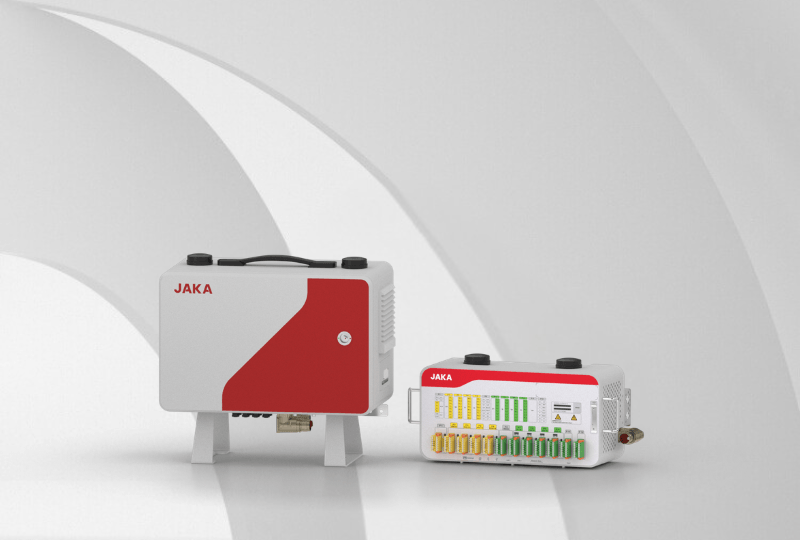
More computing power, greater connectivity, simpler maintenance and more flexible installation — the new JAKA CAB V3 brings a new generation of control technology to our cobot portfolio.
As automation applications continue to become more demanding, the controller behind a cobot plays an increasingly important role. That is why we are introducing the JAKA CAB V3, our next-generation robot control platform, designed to make automation faster, more flexible and easier to integrate and maintain.
At first glance, the CAB V3 may look like its predecessor. Inside, however, almost every aspect of the cabinet has been redesigned to deliver a significant step forward in performance, connectivity and usability.
More computing power for more responsive automation
At the heart of the CAB V3 is a new industrial PC powered by a 12th-generation CPU. According to the CAB V3 performance benchmark, the new control cabinet delivers substantially higher computing performance than the previous version.
For users, that translates into practical improvements: faster startup, quicker program loading, a more responsive user interface and smoother robot motion.
The additional computing capacity also gives the platform more headroom for future software developments, helping ensure that the controller can continue to support evolving automation requirements.
Connectivity built for modern automation
One of the key developments in the CAB V3 is its expanded connectivity.
Unlike the previous CAB V2.1, the controller features dedicated standard and safety I/O, separating these resources rather than requiring them to share capacity. The result is greater flexibility when connecting sensors, actuators and other equipment around the robot.
The CAB V3 provides 16 digital inputs and 16 digital outputs, alongside 16 safety inputs and 16 safety outputs. It also includes emergency-stop and protective-stop inputs, as well as high-speed inputs supporting 5V/24V differential encoders.
Another major addition is EtherCAT Master functionality. This makes it easier to integrate external motion and automation equipment, such as linear rails and rotary positioners, and opens up more possibilities for building coordinated, multi-device automation systems.
The controller supports industrial communication standards including PROFINET IO Device, EtherNet/IP Adapter, Modbus RTU and Modbus TCP, with further expansion options available.
Designed to make maintenance easier
Performance is only part of the story. For automation systems, keeping equipment running and making troubleshooting straightforward are just as important.
The CAB V3 has been redesigned with a more modular architecture, using 30% fewer components and 50% fewer cables compared to the previous CAB V2.1. This simplifies the internal structure and helps reduce the time required for maintenance.
The controller also features 16 integrated status LEDs, making it easier to identify system conditions and diagnose issues quickly. With its modular design, the CAB V3 has a specified mean time to repair (MTTR) of less than 15 minutes.
That can make a real difference on the factory floor — particularly when troubleshooting needs to be carried out quickly or by personnel who are not specialists in controller hardware.
Flexible enough to fit different applications
Not every automation project has the same installation requirements. The CAB V3 is therefore available in several configurations, including CAB L, CAB H, CAB LiteAC and CAB LiteDC.
For applications where space and weight are critical, the CAB Lite versions offer a particularly compact solution. The CAB LiteAC weighs 4.8 kg, while the CAB LiteDC weighs just 3.5 kg. The LiteDC version operates from 48 VDC, while the LiteAC version supports 100–240 VAC.
The compact design also supports flexible installation options, including floor, suspended, rear-rail and bracket mounting.
This makes the CAB V3 suitable for applications where the controller needs to be integrated into a compact machine, mobile robotic system or existing control cabinet.
What does this mean for existing JAKA users?
The introduction of a new controller does not mean that every existing system needs to be upgraded immediately.
If a current CAB V2.1 installation already meets its application requirements, there may be no immediate reason to replace it.
However, for customers planning a new automation project, or those looking for more I/O capacity, higher computing performance, easier maintenance or greater connectivity, the CAB V3 offers clear advantages.
The new controller is designed not only to improve today's applications, but also to provide a stronger platform for the software and automation requirements of tomorrow.
A platform for the next generation of automation
The CAB V3 is now standard with all new JAKA cobots and is also available as a standalone upgrade for most existing JAKA cobots. The JAKA Mini Series is the exception and continues to use the MiniCab.
With higher computing performance, expanded I/O, EtherCAT connectivity, a more modular design and flexible installation options, the CAB V3 brings significant improvements to the way JAKA cobots are controlled, connected and maintained.
For customers, that means a control cabinet that is faster, easier to integrate and simpler to maintain — while providing the flexibility needed for new and evolving automation applications.
The JAKA CAB V3 is now available, bringing the next generation of cobot control to automation.
'%3e%3cpath%20id='路径_17618'%20data-name='路径%2017618'%20d='M10.031,8,6,11.455l4.031,4.031'%20fill='none'%20stroke='%23333'%20stroke-linecap='round'%20stroke-linejoin='round'%20stroke-width='2'/%3e%3cpath%20id='路径_17619'%20data-name='路径%2017619'%20d='M6,14H19.24a7.486,7.486,0,1,1,0,14.971H9.454'%20transform='translate(0%20-2.545)'%20fill='none'%20stroke='%23333'%20stroke-linecap='round'%20stroke-linejoin='round'%20stroke-width='2'/%3e%3c/g%3e%3c/svg%3e)
'%3e%3cpath%20id='路径_17618'%20data-name='路径%2017618'%20d='M10.031,8,6,11.455l4.031,4.031'%20fill='none'%20stroke='%23fff'%20stroke-linecap='round'%20stroke-linejoin='round'%20stroke-width='2'/%3e%3cpath%20id='路径_17619'%20data-name='路径%2017619'%20d='M6,14H19.24a7.486,7.486,0,1,1,0,14.971H9.454'%20transform='translate(0%20-2.545)'%20fill='none'%20stroke='%23fff'%20stroke-linecap='round'%20stroke-linejoin='round'%20stroke-width='2'/%3e%3c/g%3e%3c/svg%3e) Return to List
Return to List


90766 Fuerth, Germany
'%3e%3ccircle%20id='椭圆_7060'%20data-name='椭圆%207060'%20cx='50'%20cy='50'%20r='50'%20transform='translate(134%209657)'%20fill='%23d80c1e'/%3e%3cpath%20id='路径_21623'%20data-name='路径%2021623'%20d='M947.11,3321.132s-4.227,8.162,4.833,24.7c.065.116.129.23.195.346s.124.234.187.354c9.06,16.532,18.214,17.362,18.214,17.362a4.8,4.8,0,0,0,2.246-.177,17.018,17.018,0,0,0,4.229-2.687c1.79-1.639.384-5.317-.541-7.009-1.876-3.422-4.162-4.65-5.447-4.225-.577.188-3.1,1.7-3.1,1.7a2.855,2.855,0,0,1-1.86.213s-3.357-.941-7.792-8.892c-4.309-8.01-3.3-11.347-3.3-11.347a2.854,2.854,0,0,1,1.182-1.455s3.069-1.675,3.1-1.7c1.229-.863.555-4.1-.63-6.864a6.434,6.434,0,0,0-3.163-3.754c-2.256-1.158-7.477.768-8.349,3.436Z'%20transform='translate(-778%206368.353)'%20fill='%23fff'/%3e%3c/g%3e%3c/svg%3e)
90766 Fuerth, Germany


'%3e%3cpath%20id='路径_21593'%20data-name='路径%2021593'%20d='M-971.813,3958.813l5.517-5.517,5.517,5.517'%20fill='none'%20stroke='%23d80c1e'%20stroke-linecap='round'%20stroke-linejoin='round'%20stroke-width='1'/%3e%3cline%20id='直线_13976'%20data-name='直线%2013976'%20y2='15.981'%20transform='translate(-966.296%203953.296)'%20fill='none'%20stroke='%23d80c1e'%20stroke-linecap='round'%20stroke-linejoin='round'%20stroke-width='1'/%3e%3cline%20id='直线_13977'%20data-name='直线%2013977'%20x2='8.519'%20transform='translate(-970.556%203952.778)'%20fill='none'%20stroke='%23d80c1e'%20stroke-linecap='round'%20stroke-linejoin='round'%20stroke-width='1'/%3e%3c/g%3e%3c/svg%3e)
'%3e%3cpath%20id='路径_21593'%20data-name='路径%2021593'%20d='M-971.813,3958.813l5.517-5.517,5.517,5.517'%20fill='none'%20stroke='%23fff'%20stroke-linecap='round'%20stroke-linejoin='round'%20stroke-width='1'/%3e%3cline%20id='直线_13976'%20data-name='直线%2013976'%20y2='15.981'%20transform='translate(-966.296%203953.296)'%20fill='none'%20stroke='%23fff'%20stroke-linecap='round'%20stroke-linejoin='round'%20stroke-width='1'/%3e%3cline%20id='直线_13977'%20data-name='直线%2013977'%20x2='8.519'%20transform='translate(-970.556%203952.778)'%20fill='none'%20stroke='%23fff'%20stroke-linecap='round'%20stroke-linejoin='round'%20stroke-width='1'/%3e%3c/g%3e%3c/svg%3e)