



'%3e%3cline%20id='直线_13422'%20data-name='直线%2013422'%20x2='29.367'%20transform='translate(23668.262%20-12026.238)%20rotate(45)'%20fill='none'%20stroke='%23000'%20stroke-linecap='round'%20stroke-width='2'/%3e%3cline%20id='直线_13423'%20data-name='直线%2013423'%20x2='29.367'%20transform='translate(23689.027%20-12026.238)%20rotate(135)'%20fill='none'%20stroke='%23000'%20stroke-linecap='round'%20stroke-width='2'/%3e%3c/g%3e%3c/svg%3e)
'%3e%3cpath%20id='路径_21753'%20data-name='路径%2021753'%20d='M25.248,22.5A8.248,8.248,0,1,0,17,14.248,8.248,8.248,0,0,0,25.248,22.5Z'%20transform='translate(-0.33%20-1.695)'%20fill='none'%20stroke='%23000'%20stroke-linecap='round'%20stroke-linejoin='round'%20stroke-width='4'/%3e%3cpath%20id='路径_21754'%20data-name='路径%2021754'%20d='M6,41.453v1.261H43.837V41.453c0-4.709,0-7.064-.916-8.862a8.409,8.409,0,0,0-3.675-3.675C37.448,28,35.093,28,30.384,28H19.453c-4.709,0-7.064,0-8.862.916a8.408,8.408,0,0,0-3.675,3.675C6,34.39,6,36.744,6,41.453Z'%20transform='translate(0%201.209)'%20fill='none'%20stroke='%23000'%20stroke-linecap='round'%20stroke-linejoin='round'%20stroke-width='4'/%3e%3c/g%3e%3c/svg%3e)


'%3e%3cpath%20id='路径_20744'%20data-name='路径%2020744'%20d='M5,19H22.665v9.762a.93.93,0,0,1-.93.93H5.93a.93.93,0,0,1-.93-.93Z'%20transform='translate(0%20-8.027)'%20fill='none'%20stroke='%23999'%20stroke-linejoin='round'%20stroke-width='1.5'/%3e%3cpath%20id='路径_20745'%20data-name='路径%2020745'%20d='M5,7.93A.93.93,0,0,1,5.93,7H21.735a.93.93,0,0,1,.93.93v4.649H5Z'%20transform='translate(0%20-1.605)'%20fill='none'%20stroke='%23999'%20stroke-linejoin='round'%20stroke-width='1.5'/%3e%3cpath%20id='路径_20746'%20data-name='路径%2020746'%20d='M16,4V7.719'%20transform='translate(-5.886)'%20fill='none'%20stroke='%23999'%20stroke-linecap='round'%20stroke-linejoin='round'%20stroke-width='1.5'/%3e%3cpath%20id='路径_20747'%20data-name='路径%2020747'%20d='M32,4V7.719'%20transform='translate(-14.449)'%20fill='none'%20stroke='%23999'%20stroke-linecap='round'%20stroke-linejoin='round'%20stroke-width='1.5'/%3e%3cpath%20id='路径_20748'%20data-name='路径%2020748'%20d='M28,34h2.789'%20transform='translate(-12.308%20-16.054)'%20fill='none'%20stroke='%23999'%20stroke-linecap='round'%20stroke-linejoin='round'%20stroke-width='1.5'/%3e%3cpath%20id='路径_20749'%20data-name='路径%2020749'%20d='M14,34h2.789'%20transform='translate(-4.816%20-16.054)'%20fill='none'%20stroke='%23999'%20stroke-linecap='round'%20stroke-linejoin='round'%20stroke-width='1.5'/%3e%3cpath%20id='路径_20750'%20data-name='路径%2020750'%20d='M28,26h2.789'%20transform='translate(-12.308%20-11.773)'%20fill='none'%20stroke='%23999'%20stroke-linecap='round'%20stroke-linejoin='round'%20stroke-width='1.5'/%3e%3cpath%20id='路径_20751'%20data-name='路径%2020751'%20d='M14,26h2.789'%20transform='translate(-4.816%20-11.773)'%20fill='none'%20stroke='%23999'%20stroke-linecap='round'%20stroke-linejoin='round'%20stroke-width='1.5'/%3e%3c/g%3e%3c/svg%3e) 2026.07.02 Blog
2026.07.02 Blog


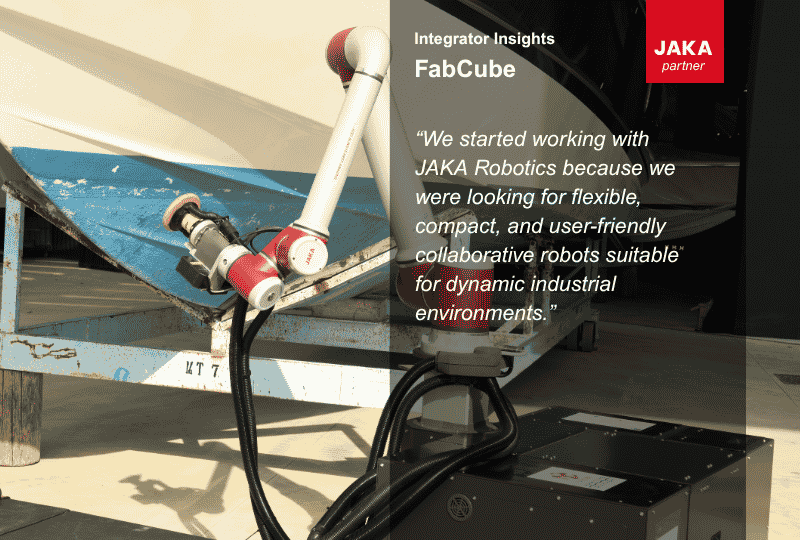
In this edition of our Integrator Insights series, we speak with Flavio Ivo Soto Carbone, mechanical designer and R&D specialist at Fabcube, an Italian company focused on automation, robotics, and industrial innovation. He shares insights into the growing demand for automation in Italy, common misconceptions about collaborative robots, and how JAKA cobots are helping companies improve productivity, safety, and operational flexibility.
Supporting Industrial Innovation Through Automation
Based in Italy, Fabcube operates as a technology integrator and innovation partner, supporting companies in the development of automation systems, digital transformation projects, and sustainable industrial solutions.
The company works with manufacturers across industries including metalworking, agro-food, textile, shipbuilding, and general manufacturing, helping them optimize production processes through automation and robotics.
“Our focus is helping companies innovate through automation, research & development, sustainability, and digital transformation,” explains Flavio.
Today, many industrial companies are facing similar challenges: labor shortages, rising operational costs, increasing demands for flexibility, and higher expectations for workplace safety and quality consistency.
“In sectors such as manufacturing and shipbuilding, repetitive manual tasks can expose operators to dust, fatigue, and physically demanding conditions,” says Flavio.
Automation as a Strategic Solution
According to Fabcube, automation has become a strategic necessity for companies that want to remain competitive in modern manufacturing.
Collaborative robots and intelligent automation systems help companies:
- Improve productivity and process consistency
- Reduce repetitive manual work
- Increase workplace safety
- Optimize resource allocation
- Allow operators to focus on higher-value activities
One project that perfectly represents this approach is B.O.C.A.S. (Boat Care Automation System), an autonomous robotic platform developed for automated sanding, polishing, and maintenance of boat hulls in shipyards.
The system combines 3D modeling, radar sensors, and robotic automation to analyze hull surfaces and perform operations such as sanding, polishing, and surface inspection with high consistency and precision.
A key advantage of the solution is the reduction of operator exposure to sanding dust and physically demanding work while maintaining constant quality throughout the process.
Why Fabcube Chose JAKA Robotics
When searching for collaborative robot solutions, Fabcube was looking for cobots that combined flexibility, compact design, and ease of integration.
“We started working with JAKA Robotics because we were looking for flexible, compact, and user-friendly collaborative robots suitable for dynamic industrial environments,” Flavio explains.
According to him, the main advantages of JAKA cobots include:
- Ease of integration
- Advanced collaborative features
- Compact design
- Flexibility in application development
- Excellent balance between performance and accessibility
“These characteristics fit perfectly with our innovation-oriented approach and with projects requiring adaptable robotic systems,” he adds.
Applications Powered by JAKA Cobots
Today, Fabcube integrates JAKA cobots into a variety of industrial applications, including:
- Sanding and polishing
- Automated inspection
- Machine tending
- Material handling
- Quality control
- R&D and prototyping projects
The company has seen strong customer benefits from collaborative automation, including improved process consistency, reduced operator fatigue, increased productivity, safer working conditions, and greater operational flexibility.
Common Misconceptions About Cobots
Despite the rapid growth of collaborative robotics in Italy, some misconceptions still remain.
“One of the most common misunderstandings is that cobots completely replace human workers,” says Flavio. “In reality, cobots are designed to collaborate with operators, improving ergonomics, safety, and productivity rather than eliminating human contribution.”
Another common misconception is that automation is only suitable for large-scale manufacturers.
“Today, cobots are flexible and economically accessible even for SMEs and highly customized production environments,” he explains.
Many customers are also surprised by how quickly collaborative robots can be integrated into existing workflows without requiring major infrastructure changes.
Building Successful Automation Projects
Fabcube believes that successful automation projects require more than simply installing a robot.
Companies often underestimate the importance of process analysis, operator training, integration planning, and organizational change management during the implementation phase.
The company recommends that businesses:
- Start with a clear analysis of repetitive and high-impact tasks
- Involve operators early in the process
- Choose scalable solutions
- Focus on long-term operational benefits rather than only short-term ROI
“A successful cobot implementation is not just about installing a robot — it is about redesigning processes to create a more efficient, safe, and sustainable production environment,” Flavio concludes.
The Growing Role of Cobots in Italy
The automation market in Italy continues to grow rapidly, driven by Industry 4.0 and Transition 5.0 initiatives. Awareness of collaborative robotics has increased significantly in recent years, particularly among SMEs looking for flexible and accessible automation solutions.
Through partnerships with innovative companies like Fabcube, JAKA Robotics continues supporting manufacturers in building smarter, safer, and more sustainable production environments.
'%3e%3cpath%20id='路径_17618'%20data-name='路径%2017618'%20d='M10.031,8,6,11.455l4.031,4.031'%20fill='none'%20stroke='%23333'%20stroke-linecap='round'%20stroke-linejoin='round'%20stroke-width='2'/%3e%3cpath%20id='路径_17619'%20data-name='路径%2017619'%20d='M6,14H19.24a7.486,7.486,0,1,1,0,14.971H9.454'%20transform='translate(0%20-2.545)'%20fill='none'%20stroke='%23333'%20stroke-linecap='round'%20stroke-linejoin='round'%20stroke-width='2'/%3e%3c/g%3e%3c/svg%3e)
'%3e%3cpath%20id='路径_17618'%20data-name='路径%2017618'%20d='M10.031,8,6,11.455l4.031,4.031'%20fill='none'%20stroke='%23fff'%20stroke-linecap='round'%20stroke-linejoin='round'%20stroke-width='2'/%3e%3cpath%20id='路径_17619'%20data-name='路径%2017619'%20d='M6,14H19.24a7.486,7.486,0,1,1,0,14.971H9.454'%20transform='translate(0%20-2.545)'%20fill='none'%20stroke='%23fff'%20stroke-linecap='round'%20stroke-linejoin='round'%20stroke-width='2'/%3e%3c/g%3e%3c/svg%3e) Return to List
Return to List


90766 Fuerth, Germany
'%3e%3ccircle%20id='椭圆_7060'%20data-name='椭圆%207060'%20cx='50'%20cy='50'%20r='50'%20transform='translate(134%209657)'%20fill='%23d80c1e'/%3e%3cpath%20id='路径_21623'%20data-name='路径%2021623'%20d='M947.11,3321.132s-4.227,8.162,4.833,24.7c.065.116.129.23.195.346s.124.234.187.354c9.06,16.532,18.214,17.362,18.214,17.362a4.8,4.8,0,0,0,2.246-.177,17.018,17.018,0,0,0,4.229-2.687c1.79-1.639.384-5.317-.541-7.009-1.876-3.422-4.162-4.65-5.447-4.225-.577.188-3.1,1.7-3.1,1.7a2.855,2.855,0,0,1-1.86.213s-3.357-.941-7.792-8.892c-4.309-8.01-3.3-11.347-3.3-11.347a2.854,2.854,0,0,1,1.182-1.455s3.069-1.675,3.1-1.7c1.229-.863.555-4.1-.63-6.864a6.434,6.434,0,0,0-3.163-3.754c-2.256-1.158-7.477.768-8.349,3.436Z'%20transform='translate(-778%206368.353)'%20fill='%23fff'/%3e%3c/g%3e%3c/svg%3e)
90766 Fuerth, Germany


'%3e%3cpath%20id='路径_21593'%20data-name='路径%2021593'%20d='M-971.813,3958.813l5.517-5.517,5.517,5.517'%20fill='none'%20stroke='%23d80c1e'%20stroke-linecap='round'%20stroke-linejoin='round'%20stroke-width='1'/%3e%3cline%20id='直线_13976'%20data-name='直线%2013976'%20y2='15.981'%20transform='translate(-966.296%203953.296)'%20fill='none'%20stroke='%23d80c1e'%20stroke-linecap='round'%20stroke-linejoin='round'%20stroke-width='1'/%3e%3cline%20id='直线_13977'%20data-name='直线%2013977'%20x2='8.519'%20transform='translate(-970.556%203952.778)'%20fill='none'%20stroke='%23d80c1e'%20stroke-linecap='round'%20stroke-linejoin='round'%20stroke-width='1'/%3e%3c/g%3e%3c/svg%3e)
'%3e%3cpath%20id='路径_21593'%20data-name='路径%2021593'%20d='M-971.813,3958.813l5.517-5.517,5.517,5.517'%20fill='none'%20stroke='%23fff'%20stroke-linecap='round'%20stroke-linejoin='round'%20stroke-width='1'/%3e%3cline%20id='直线_13976'%20data-name='直线%2013976'%20y2='15.981'%20transform='translate(-966.296%203953.296)'%20fill='none'%20stroke='%23fff'%20stroke-linecap='round'%20stroke-linejoin='round'%20stroke-width='1'/%3e%3cline%20id='直线_13977'%20data-name='直线%2013977'%20x2='8.519'%20transform='translate(-970.556%203952.778)'%20fill='none'%20stroke='%23fff'%20stroke-linecap='round'%20stroke-linejoin='round'%20stroke-width='1'/%3e%3c/g%3e%3c/svg%3e)