



'%3e%3cline%20id='直线_13422'%20data-name='直线%2013422'%20x2='29.367'%20transform='translate(23668.262%20-12026.238)%20rotate(45)'%20fill='none'%20stroke='%23000'%20stroke-linecap='round'%20stroke-width='2'/%3e%3cline%20id='直线_13423'%20data-name='直线%2013423'%20x2='29.367'%20transform='translate(23689.027%20-12026.238)%20rotate(135)'%20fill='none'%20stroke='%23000'%20stroke-linecap='round'%20stroke-width='2'/%3e%3c/g%3e%3c/svg%3e)
'%3e%3cpath%20id='路径_21753'%20data-name='路径%2021753'%20d='M25.248,22.5A8.248,8.248,0,1,0,17,14.248,8.248,8.248,0,0,0,25.248,22.5Z'%20transform='translate(-0.33%20-1.695)'%20fill='none'%20stroke='%23000'%20stroke-linecap='round'%20stroke-linejoin='round'%20stroke-width='4'/%3e%3cpath%20id='路径_21754'%20data-name='路径%2021754'%20d='M6,41.453v1.261H43.837V41.453c0-4.709,0-7.064-.916-8.862a8.409,8.409,0,0,0-3.675-3.675C37.448,28,35.093,28,30.384,28H19.453c-4.709,0-7.064,0-8.862.916a8.408,8.408,0,0,0-3.675,3.675C6,34.39,6,36.744,6,41.453Z'%20transform='translate(0%201.209)'%20fill='none'%20stroke='%23000'%20stroke-linecap='round'%20stroke-linejoin='round'%20stroke-width='4'/%3e%3c/g%3e%3c/svg%3e)


'%3e%3cpath%20id='路径_20744'%20data-name='路径%2020744'%20d='M5,19H22.665v9.762a.93.93,0,0,1-.93.93H5.93a.93.93,0,0,1-.93-.93Z'%20transform='translate(0%20-8.027)'%20fill='none'%20stroke='%23999'%20stroke-linejoin='round'%20stroke-width='1.5'/%3e%3cpath%20id='路径_20745'%20data-name='路径%2020745'%20d='M5,7.93A.93.93,0,0,1,5.93,7H21.735a.93.93,0,0,1,.93.93v4.649H5Z'%20transform='translate(0%20-1.605)'%20fill='none'%20stroke='%23999'%20stroke-linejoin='round'%20stroke-width='1.5'/%3e%3cpath%20id='路径_20746'%20data-name='路径%2020746'%20d='M16,4V7.719'%20transform='translate(-5.886)'%20fill='none'%20stroke='%23999'%20stroke-linecap='round'%20stroke-linejoin='round'%20stroke-width='1.5'/%3e%3cpath%20id='路径_20747'%20data-name='路径%2020747'%20d='M32,4V7.719'%20transform='translate(-14.449)'%20fill='none'%20stroke='%23999'%20stroke-linecap='round'%20stroke-linejoin='round'%20stroke-width='1.5'/%3e%3cpath%20id='路径_20748'%20data-name='路径%2020748'%20d='M28,34h2.789'%20transform='translate(-12.308%20-16.054)'%20fill='none'%20stroke='%23999'%20stroke-linecap='round'%20stroke-linejoin='round'%20stroke-width='1.5'/%3e%3cpath%20id='路径_20749'%20data-name='路径%2020749'%20d='M14,34h2.789'%20transform='translate(-4.816%20-16.054)'%20fill='none'%20stroke='%23999'%20stroke-linecap='round'%20stroke-linejoin='round'%20stroke-width='1.5'/%3e%3cpath%20id='路径_20750'%20data-name='路径%2020750'%20d='M28,26h2.789'%20transform='translate(-12.308%20-11.773)'%20fill='none'%20stroke='%23999'%20stroke-linecap='round'%20stroke-linejoin='round'%20stroke-width='1.5'/%3e%3cpath%20id='路径_20751'%20data-name='路径%2020751'%20d='M14,26h2.789'%20transform='translate(-4.816%20-11.773)'%20fill='none'%20stroke='%23999'%20stroke-linecap='round'%20stroke-linejoin='round'%20stroke-width='1.5'/%3e%3c/g%3e%3c/svg%3e) 2026.07.02 News
2026.07.02 News


Boat hull preparation is one of the most physically demanding tasks in the marine industry.
The hull — the main body of a boat that sits below and above the waterline — is protecting the vessel while allowing it to move efficiently through the water. Over time, marine growth and environmental wear affect the hull's performance, which means it requires regular maintenance to remove old coatings, prepare the surface, and apply new protective finishes.
From sanding and polishing to preparing surfaces for new coatings, the process has traditionally relied on skilled operators performing repetitive work in challenging conditions.
To modernize this process, our Italian partner FabCube has developed B.O.C.A.S. (Boat Care Automation System)—an innovative autonomous solution that combines advanced robotics, intelligent sensing, and mobile automation to deliver consistent, high-quality hull finishing.
Bringing Automation to a Traditionally Manual Process
When a boat is removed from the water for maintenance, the hull undergoes several preparation stages before new coatings can be applied. Operators first remove fouling and old coatings, followed by multiple rounds of sanding, surface preparation, primer application, and finishing.
These tasks are not only time-consuming but also physically exhausting.
“Workers often spend hours operating sanding tools while working from ladders or elevated platforms to reach large hulls. Constant exposure to dust, vibrations, repetitive movements, and awkward working positions increases fatigue while making it difficult to maintain consistent finishing quality across the entire surface.” - FabCube
Recognizing these challenges, FabCube set out to develop a smarter solution that improves productivity while creating a safer and more ergonomic working environment.
Introducing B.O.C.A.S. – Boat Care Automation System
Developed as a research and development project at Porto Turistico di Jesolo, B.O.C.A.S. represents a new approach to recreational and medium-to-large boat maintenance.
Rather than relying entirely on manual labor, the system automates the sanding and polishing process using a mobile robotic platform capable of adapting to complex curved hull geometries.
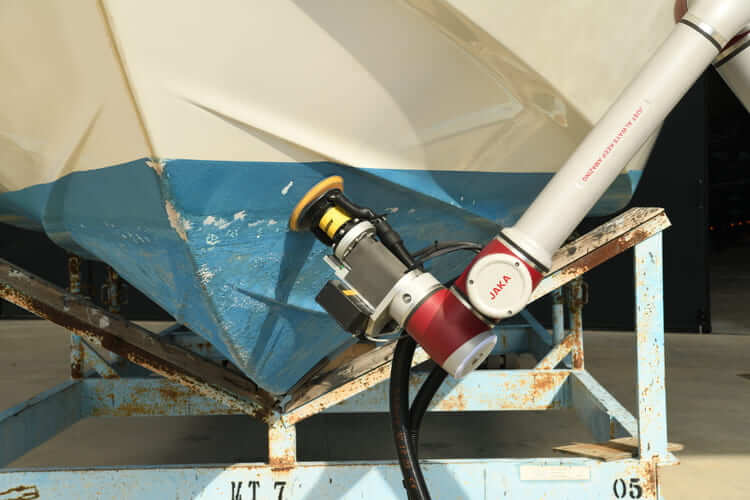
At the heart of the solution is a custom-built autonomous mobile robot (AMR) developed by FabCube. Designed for portability, the mobile platform allows operators to easily move the system around the vessel and position it
wherever sanding or polishing is required, making it well suited for dynamic marina and boatyard environments.
Mounted on the AMR are:
- JAKA PRO 16 collaborative robot
- Mirka DEROS robotic random orbital sander
- KEYENCE profilometer
- Advanced 3D modelling and sensing technologies
Together, these technologies enable the system to automatically adapt to the hull's geometry and perform high-quality sanding with precision and consistency.
Intelligent Surface Adaptation
Unlike flat industrial workpieces, boat hulls feature continuously changing curves and complex geometries.
To overcome this challenge, B.O.C.A.S. first creates a digital representation of the hull using 3D modelling. During operation, the KEYENCE profilometer continuously measures the surface profile, providing real-time feedback that allows the robot to adjust its trajectory while maintaining the desired surface finish.
Rather than inspecting defects, the system measures the surface profile and automatically adapts the sanding path to follow the hull geometry with high precision. This intelligent adaptation enables the same system to process virtually any curved surface, regardless of the material.
Why FabCube Chose the JAKA PRO 16
For an application operating outdoors in demanding marina environments, selecting the right robot was critical.
FabCube selected the JAKA PRO 16 because it combines several capabilities essential for this application.
- IP68 protection, allowing reliable operation in outdoor environments where dust, humidity, and water exposure are common.
- 16 kg payload, providing sufficient capacity for sanding tools and accessories.
- Long reach, enabling the robot to cover larger working areas while minimizing repositioning.
- Compact collaborative design, making integration onto a mobile robotic platform straightforward.
- Easy programming and deployment, allowing rapid development and flexible operation.
“In marine maintenance environments, robots are regularly exposed to dust, moisture, and water spray, so having a robot designed to withstand these conditions was a key factor in our decision. Unlike many standard industrial robots, which typically require additional protection such as covers or controlled environments to operate reliably in these conditions, the JAKA PRO 16’s IP68 protection allows it to work directly in such demanding outdoor settings.” - FabCube
Benefits for Boat Maintenance
By automating one of the most labor-intensive stages of boat maintenance, B.O.C.A.S. delivers significant advantages for shipyards, marinas, and yacht service companies.
Key benefits includes improved process consistency, reduced operator fatigue, higher productivity, safer working conditions, improved quality control as well as greater operational flexibility thanks to the solutions' mobile design.
Instead of replacing skilled workers, the system allows operators to supervise the process while the robot performs the repetitive finishing work with repeatable precision.
A Flexible Platform for Curved Surface Processing
Although B.O.C.A.S. was developed specifically for boat hull finishing, the technology behind the solution extends far beyond the marine industry.
Its combination of mobile robotics, real-time surface measurement, and adaptive robotic motion makes it suitable for processing a wide variety of large curved surfaces where consistent sanding or polishing is required.
As industries continue to seek smarter ways to automate manual finishing processes, solutions like B.O.C.A.S. demonstrate how collaborative robotics can improve quality, safety, and productivity - even in applications that have traditionally depended entirely on manual craftsmanship.
'%3e%3cpath%20id='路径_17618'%20data-name='路径%2017618'%20d='M10.031,8,6,11.455l4.031,4.031'%20fill='none'%20stroke='%23333'%20stroke-linecap='round'%20stroke-linejoin='round'%20stroke-width='2'/%3e%3cpath%20id='路径_17619'%20data-name='路径%2017619'%20d='M6,14H19.24a7.486,7.486,0,1,1,0,14.971H9.454'%20transform='translate(0%20-2.545)'%20fill='none'%20stroke='%23333'%20stroke-linecap='round'%20stroke-linejoin='round'%20stroke-width='2'/%3e%3c/g%3e%3c/svg%3e)
'%3e%3cpath%20id='路径_17618'%20data-name='路径%2017618'%20d='M10.031,8,6,11.455l4.031,4.031'%20fill='none'%20stroke='%23fff'%20stroke-linecap='round'%20stroke-linejoin='round'%20stroke-width='2'/%3e%3cpath%20id='路径_17619'%20data-name='路径%2017619'%20d='M6,14H19.24a7.486,7.486,0,1,1,0,14.971H9.454'%20transform='translate(0%20-2.545)'%20fill='none'%20stroke='%23fff'%20stroke-linecap='round'%20stroke-linejoin='round'%20stroke-width='2'/%3e%3c/g%3e%3c/svg%3e) Return to List
Return to List


90766 Fuerth, Germany
'%3e%3ccircle%20id='椭圆_7060'%20data-name='椭圆%207060'%20cx='50'%20cy='50'%20r='50'%20transform='translate(134%209657)'%20fill='%23d80c1e'/%3e%3cpath%20id='路径_21623'%20data-name='路径%2021623'%20d='M947.11,3321.132s-4.227,8.162,4.833,24.7c.065.116.129.23.195.346s.124.234.187.354c9.06,16.532,18.214,17.362,18.214,17.362a4.8,4.8,0,0,0,2.246-.177,17.018,17.018,0,0,0,4.229-2.687c1.79-1.639.384-5.317-.541-7.009-1.876-3.422-4.162-4.65-5.447-4.225-.577.188-3.1,1.7-3.1,1.7a2.855,2.855,0,0,1-1.86.213s-3.357-.941-7.792-8.892c-4.309-8.01-3.3-11.347-3.3-11.347a2.854,2.854,0,0,1,1.182-1.455s3.069-1.675,3.1-1.7c1.229-.863.555-4.1-.63-6.864a6.434,6.434,0,0,0-3.163-3.754c-2.256-1.158-7.477.768-8.349,3.436Z'%20transform='translate(-778%206368.353)'%20fill='%23fff'/%3e%3c/g%3e%3c/svg%3e)
90766 Fuerth, Germany


'%3e%3cpath%20id='路径_21593'%20data-name='路径%2021593'%20d='M-971.813,3958.813l5.517-5.517,5.517,5.517'%20fill='none'%20stroke='%23d80c1e'%20stroke-linecap='round'%20stroke-linejoin='round'%20stroke-width='1'/%3e%3cline%20id='直线_13976'%20data-name='直线%2013976'%20y2='15.981'%20transform='translate(-966.296%203953.296)'%20fill='none'%20stroke='%23d80c1e'%20stroke-linecap='round'%20stroke-linejoin='round'%20stroke-width='1'/%3e%3cline%20id='直线_13977'%20data-name='直线%2013977'%20x2='8.519'%20transform='translate(-970.556%203952.778)'%20fill='none'%20stroke='%23d80c1e'%20stroke-linecap='round'%20stroke-linejoin='round'%20stroke-width='1'/%3e%3c/g%3e%3c/svg%3e)
'%3e%3cpath%20id='路径_21593'%20data-name='路径%2021593'%20d='M-971.813,3958.813l5.517-5.517,5.517,5.517'%20fill='none'%20stroke='%23fff'%20stroke-linecap='round'%20stroke-linejoin='round'%20stroke-width='1'/%3e%3cline%20id='直线_13976'%20data-name='直线%2013976'%20y2='15.981'%20transform='translate(-966.296%203953.296)'%20fill='none'%20stroke='%23fff'%20stroke-linecap='round'%20stroke-linejoin='round'%20stroke-width='1'/%3e%3cline%20id='直线_13977'%20data-name='直线%2013977'%20x2='8.519'%20transform='translate(-970.556%203952.778)'%20fill='none'%20stroke='%23fff'%20stroke-linecap='round'%20stroke-linejoin='round'%20stroke-width='1'/%3e%3c/g%3e%3c/svg%3e)